Your hub’s funding and reporting

This section steps through the finance and reporting responsibilities for your community hub. There are two types of funding:

  • Hub funding – this covers the salaries of your hub plus associated costs of those employed in your hub, and
  • English and childminding funding – this is for your hub to deliver conversational English classes with childminding support.

Your school’s hub contract for the next three years

The current hub contract for all host schools ends 30 June, 2026. 

We are delighted to confirm the federal government has committed to fund hubs for a further three years to June 2029 and also provide additional funding for English classes (with childminding support where needed). This is testament to the wonderful work hubs do and the important role they play in communities across Australia.

The new hub contracts – 1 July 2026 to 30 June 2029 – will be shared with your school for signing before the end of Term 1 and need to be returned to us by 15 May 2026. 

Inclusion of English and childminding funding in the new hub contracts

We receive funding from federal government to provide hubs with funding to run English classes and where needed, childminding to support this activity. This funding will now be part of your school’s new 3-year contract, making it simpler for you to access this funding and have more flexibility in responding to changing community needs.

The current contract we have with your school includes hub funding only. Where needed, English and childminding funding has been applied for by your hub leader separately.

In the new hub contract, schools that choose to receive funding for English and childminding from us will be given a set amount of funding upfront, in the same way (and at the same time) that hub funding is provided, every six months. The school will then pay the providers, removing the need to give us quotes ahead of time and invoices at the end of each term.


Current contract

Schools receive funding for the hub through a 3-year contract with payments made to the school every six months.

Hub leaders apply to CHA for English and childminding funding every six months and then submit invoices to CHA for payment during subsequent school terms.


New contract

Schools receive hub funding and English and childminding funding through a 3-year contract with CHA with payments made to the school every six months. The school is responsible for paying third party invoices from English facilitators and childminders (if applicable).

To learn more about English and childminding funding guidelines, reporting requirements and answers to other common questions, please see Frequently Asked Questions below or here as a pdf.

Returning your signed contract

Maurice has emailed the hub contract to all Principals with instructions on how to upload the contract to SmartyGrants once it has been signed. Please know that you have the option to ‘opt out’ of receiving English and childminding funding when you upload your signed contract in the SmartyGrants form given several schools either have classes funded through other avenues or there isn’t a need for English classes in their community.

Information session for you to learn everything you need to know about your school’s new contract

Understanding that you may have questions about your new contract, including the addition of English and childminding funding, we are holding information sessions for Principals and business managers at the end of this term and the beginning of Term 2.

To register your attendance, please click on one of the following links:

Tuesday, 24 March 11.00 am – 12.00 pm AEDT
Wednesday, 25 March 1.00 pm – 2.00 pm AEDT
Thursday, 26 March 10.30 am – 11.30 am AEDT
Tuesday, 28 April 1.00 pm – 2.00 pm AEST
Wednesday, 29 April 11.00 am – 12.00 pm AEST
Thursday, 30 April 2.00 pm – 3.00 pm AEST

Of course, you are always welcome to contact our Operations Manager, Maurice Syber at mauricesyber@communityhubs.org.au with any questions you have.

Frequently Asked Questions (FAQs)

PDF of FAQs available to download here.

What is changing?
By providing English and childminding funding upfront, we have removed the need for your school to apply for a specified amount of funding and then submit invoices at the end of each term. The funding guidelines (how it can be spent) and reporting requirements have not changed.

Why are you making the change? It’s worked well for us.
In listening to hub leaders and business managers, we wanted to make it easier for you to access funds to run English classes, with childminding support where needed. The current application, approval and invoicing process requires a lot of time and work from each school. Feedback we received from schools indicated that providing English and childminding funding as part of the hub contract would streamline the process and give schools more certainty about the amount of funding available to them, and more flexibility to allow for changes during the term. This in turn makes it easier to plan English classes as part of hub activity.

How much funding will my hub have for English classes and childminding to support them?
Each school (unless they have chosen not to receive it) will receive a set amount of funding on 31 July and 31 January each year. For most schools this will be $8,000 ex-GST. For schools that have historically required a lower amount of English and childminding funding, the CHA team has worked with those schools to provide a smaller amount based on the hub’s needs.

Do I still need to submit a funding application?
No, you will have a set amount of funding provided on 31 July and 31 January each year, unless you opt out of receiving English and childminding funding. You can use the funding to pay English teachers and/or childminders supporting English classes.

If I opted out of receiving English and childminding funding, can I opt back in?
Yes, you can apply to opt back in. Approval will only be granted if you can demonstrate a need and if we have funds available.

If we don’t use all the funding in a six-month period, can we use it in the next period?
Yes. When planning English classes, confirm with your business manager how much English and childminding funding you have.

Can the funding be used for other activities where the participants speak English (eg. sewing or cooking classes)?
No. To understand what the funding can and cannot be used for, visit https://hubtoolbox.communityhubs.org.au/hub-leader-toolbox/planning-reporting/grants-scholarships/english-and-childminding-funding/ .

Click on ‘>English’ to see how English funding can and cannot be used and click on ‘>Childminding’ to see how childminding funding can and cannot be used.

Can the funding be used for other activities childminding to support other activities?
No.

Can the funding be used for resources, excursions, annual or personal leave, super etc.?
No.

Can I use childminding funding to pay a childminder to support an English class not funded by CHA?
Yes, that’s fine.

Can I use childminding funding to pay for a childminder to look after the English facilitator’s child?
The funding is to be used for a childminder to look after the children of hub participants’ attending the English class. It is fine for the childminder to look after the English facilitator’s child, but only if they are also looking after children of hub participants attending the English class. Childminding funding cannot be used for a childminder to look after the English facilitator’s child only.

Can I use funding to cover English class preparation?
Preparation and administration time for English facilitators will be covered, however it must be reasonable. For more information see the hub leader Hub Toolbox page: https://hubtoolbox.communityhubs.org.au/hub-leader-toolbox/planning-reporting/grants-scholarships/english-and-childminding-funding/

My English class is two hours in duration and my childminder needs to be paid for three hours (as a minimum requirement). Can I use the childminding funding to pay the facilitator to do other non-childminding tasks in the hub or school for the extra hour?
No. Funding can only be used to pay the childminder for the hours they are childminding which includes the setting up, and putting way, of toys and books. Payment for non-childminding activities is the responsibility of the school.

Do English teachers need to have an English teaching qualification?
For a formal English class (e.g. Certificate III in English), the English facilitator should be suitably qualified i.e. hold an adult English teaching qualification such as Teaching English to Speakers of Other Languages (TESOL), or a Certificate in English Language Teaching to Adults (CELTA). For an informal class, for example, conversational English, the facilitator needs to have relevant skills and experience, for example, experience in teaching adult learners. It is up to each school to decide which providers they work with.

Do childminders need to have a childcare qualification? How many children can they look after?
Childminding funding can be used to pay for childminding, not childcare. Childminders do not require special qualifications or child to worker ratios like childcare workers, who have full responsibility of the children they look after. A childminder looks after the children of hub participants and should be in the same building as the parent who remains responsible for the child’s behaviour, safety and wellbeing. Many hubs employ a hub participant as a childminder as a way of supporting them with paid employment. For many, it’s their first job in Australia.

Do I have to employ the English teacher or childminder?
That is not a requirement of the funding. Every school is different and has its own processes for working with providers. We recommend you follow the same process you do for other non-school providers who are paid to deliver services in the school.

What is the usual rate of pay for an English teacher or childminder?
Hourly rates vary widely between providers. It is up to each school to decide which providers they work with and agree together on the cost for services provided.

Do I now have a responsibility to screen all childminders?
Your responsibilities as a school do not change along with this new process of providing English and childminding funding. You should continue to follow your usual processes for screening childminders and other people on school premises that work with children.

Do I still need to request lesson plans from English providers?
This is good practice to ensure the English classes are being prepared and delivered by a teacher with suitable skills and experience, and that the primary focus is English. We may request to see the lesson plans as part of our internal checks.

If the plans for English classes change during the term (for example, there is a change in the English teacher/childminder, or we need to add another class or change the number of weeks) do we need to notify CHA?
No, the school has the autonomy to decide how to use the funding provided and to change plans as needed (provided it is within the guidelines) without having to notify CHA. You should discuss any changes with your provider and document what you have agreed to. Be sure to check the invoices at the end of term to make sure they are correct.

Do we still need to gather information about attendance and participants?
Yes, this funding from DHA has reporting requirements that still apply. Hub leaders should continue the current processes including:

  • recording in Hub Portal how many adults and children attend each session
  • new participants completing a visa category form each term and
  • regular participants completing a measure of English progress form

Do I still need to complete a hub leader program and expenditure summary?
No, this information is now collected through the acquittal process, which your school business manager will complete, and the measure of English progress form.

Do I still need to collect quotes from my providers?
This is good practice for any provider delivering a service in your hub, however, you no longer need to submit the quotes ahead of time. We encourage you to compare the invoices you receive at the end of each term with the quote and question any discrepancies. We may request to see the quotes as part of our internal checks.

Do I still need to submit invoices from providers to CHA?
No, the school will review and pay the invoices from providers. While you no longer need to submit invoices to us at the end of each term, we may request to see the invoices as part of our internal checks.

How will hub funding and English and childminding funding be paid?
Both hub funding and English and childminding funding will be paid by separate recipient created tax invoices (RCTI). This is a payment method in which the recipient of goods or services (in this case, Community Hubs Australia) raises a purchase order on behalf of the supplier of the goods or services (in this case, your school). 

Every six months, CHA will automatically issue schools with two RCTI, payment to a nominated school bank account, and following payment, a remittance advice. Note that if your school is not receiving English and childminding funding, your school will only receive one RCTI for hub funding.

Please note: For NSW government schools – the RCTIs will be sent to your school, indicating the amount of funding your school will receive. The funds will be paid directly to EDConnect who will journal the funds directly to your school.

What does the payment process look like?
It will work in the same way it has for hub funding since 2023.

  1. Before payment, your school will receive two RCTIs from accounts@communityhubs.org.au. (if you are not receiving English and childminding funding, you will receive one RCTI).

    The RCTI provides an account of the funding that will be paid to your school for the 31 July and 31 January milestone payments (as set out in your contract/MOU with us). To see an example, click hub funding RCTI example and English and childminding RCTI example. For NSW government schools, click hub funding RCTI example and English and childminding RCTI example.

  2. Funds will be transferred to your nominated school bank account via electronic funds transfer (EFT) on the milestone payment date of 31 July and 31 January. For NSW government schools, funds will be transferred to EDConnect. 

  3. Following payment, your school will receive a remittance advice from accounts@communityhubs.org.au confirming funds have been transferred to your school’s bank account. To see an example, click here.  For NSW government schools, EDConnect will receive the remittance advice and journal the funds directly to your school. 

Should invoices from childminders include GST?
Childminding generally does not attract GST, please confirm this with your provider.

Should invoices from English teachers include GST?
English classes may or may not attract GST (depending on whether they are registered for GST). Talk to your provider if you have questions about their invoice.

What do I do with the GST component of the RCTI?
The GST for English and childminding funding is dealt with in the same way as the GST on hub funding.

What do we do with unspent funds?
At the end of each 6-month period, you will complete an acquittal detailing how much your school has spent on both hub and English and childminding. Remaining funds can be used in the next period. If you have only used a small portion of the funds provided, and have a lot remaining, we may suggest pausing or reducing the next payment.

Do I need to acquit English and childminding funding?
Yes, you do. There are two key points in the year when your school is required to complete a financial acquittal for English and childminding funding – 31 January and 31 July. This will be a similar process to acquitting hub funding.

Your school’s current hub contract (until June 2026)

Community Hubs Australia (CHA) provides funding to schools to operate the National Community Hubs Program on their premises. The funding agreement specifies at least 90% of funding must be spent on salaries and associated costs of people employed to work in the hub.  

For the first two years of operation, CHA provides the full funding required for each community hub. From the third year onwards, this amount is reduced slightly, and schools contribute financially to the program each year. This is detailed in the funding schedule of your contract with us.  

Hub funding is paid to schools 31 January to cover the salaries of the hub for January to June, and 31 July for July to December.

Hub funding is paid by recipient created tax invoice (RCTI). This is a payment method in which the recipient of goods or services (in this case, Community Hubs Australia) raises a purchase order on behalf of the supplier of the goods or services (in this case, your school).   

Every six months, CHA automatically issues schools with a RCTI, payment to a nominated school bank account, and following payment, a remittance advice.  

Please note: For NSW government schools – the RCTI will be sent to your school, indicating the amount of funding your school will receive. The funds are paid directly to EDConnect who then journal the funds directly to your school. 

1. Before payment, your school will receive a RCTI from accounts@communityhubs.org.au. 

This document provides an account of the funding that will be paid to your school for the 31 July and 31 January milestone payments (as set out in your agreement with us). To see an example, click here. For NSW government schools, click here.

2. Funds will be transferred to your nominated school bank account via electronic funds transfer (EFT) on the milestone payment date of 31 July and 31 January. For NSW government schools, funds will be transferred to EDConnect. 

3. Following payment, your school will receive a remittance advice from accounts@communityhubs.org.au confirming funds have been transferred to your school’s bank account. To see an example, click here.  For NSW government schools, EDConnect will receive the remittance advice and will journal the funds directly to your school. 

Yes, you do. There are two key points in the year when your school is required to complete a financial acquittal for the hub funding CHA provides your school – 31 January and 31 July. 

The section below guides you through what an acquittal is, when and how to submit the acquittal, along with a video and frequently asked questions. 

 Financial acquittals

There are two key points in the year when your hub is required to complete and submit a financial acquittal for the hub funding that CHA provides31 January and 31 July. The sections below guide you through what an acquittal is, when and how to submit the acquittals, along with a video and Frequently Asked Questions (FAQs).    

A financial acquittal is a confirmation of how the hub funding CHA has[JG12.1] provided in the previous six-month period has been spent and on what. Remember, the financial acquittal specifically relates to the funding towards the salaries and associated costs of people employed to work in your hub. You need to complete the financial acquittal as an online form in SmartyGrants, including the following information:

  • Any hub funding that you have declared as carry forward from the last reporting period.  This is recorded as the balance of your last financial acquittal. 
  • The amount of hub funding your school has received from CHA to run your hub for this period (either 1 January – 30 June or 1 July – 31 December).   
  • The funding contribution your school has made in this period. Remember, if your hub has been operating for more than two years, your school is obliged under the funding agreement with CHA to contribute a set amount. Please refer to your funding agreement for details. 
  • Total funding spent on salaries and other associated costs. Remember that at least 90% of the total allocation of funding must be spent on salaries and associated costs of people employed to work in your hub. This is detailed in your funding agreement with CHA. 
  • Funding allocated to ‘other expenses’, including a brief description. 
  • Funding balance at the end of the six-month period. 
  • Any amounts as GST exclusive (e.g. $X +GST). 
  • Confirmation on whether your school’s bank account details (BSB and account number) have changed – unless you have a prior arrangement or are a NSW government school.   

Your financial acquittal does not include other program funding, for example playgroups. Note that for the July to December 2026 the acquittal will include English and childminding fundings as well as hub funding. The January to June 2026 acquittal will only be for hub funding.   

Hub funding financial acquittals are due:

1. By 31 July for the period 1 Jan to 30 June 

2. By 31 Jan for the period 1 July to 31 December

When you have collated the information for your financial acquittals, you will need to log in to SmartyGrants and complete the form online. Here’s how:

1. Go to communityhubs.smartygrants.com.au.

2. Log in using the school email address and password you’ve previously set up in SmartyGrants. 

3. Click on ‘Log in’.

4. Go to the top right corner and click on ‘My Submissions’. 

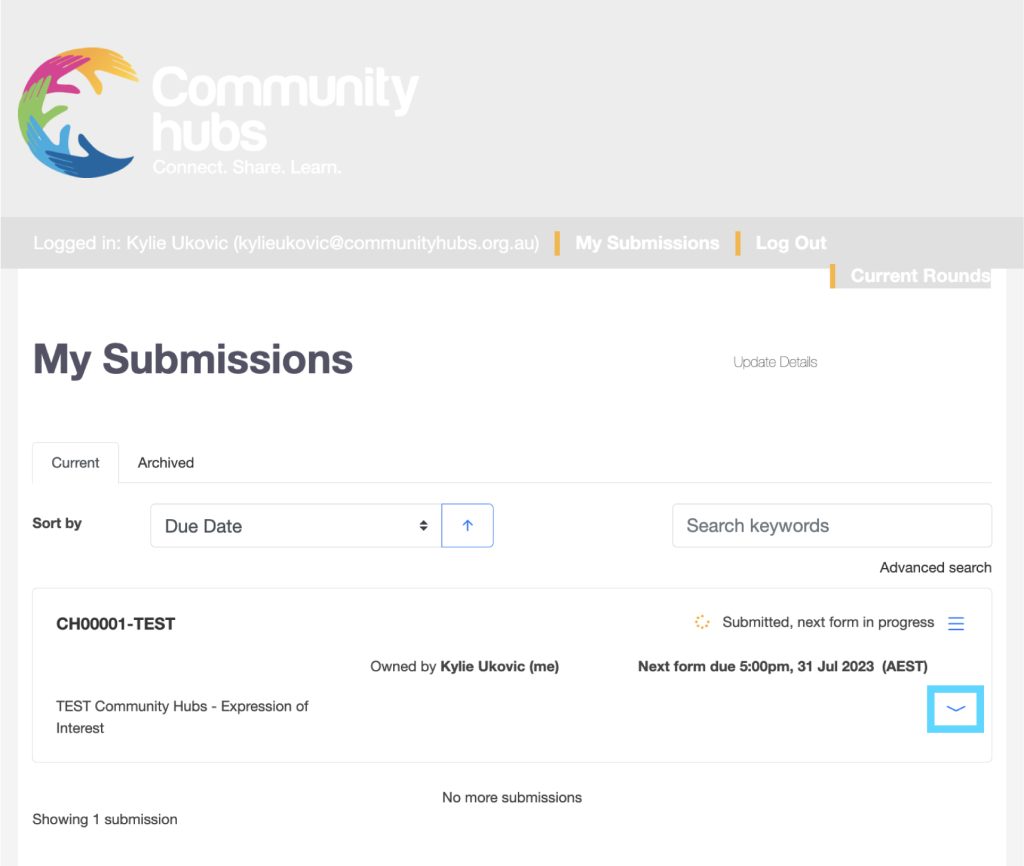
5. Underneath the application number, you will see a small blue drop-down arrow to the right (highlighted blue below). Click on the arrow and you will see the acquittal form. 
 

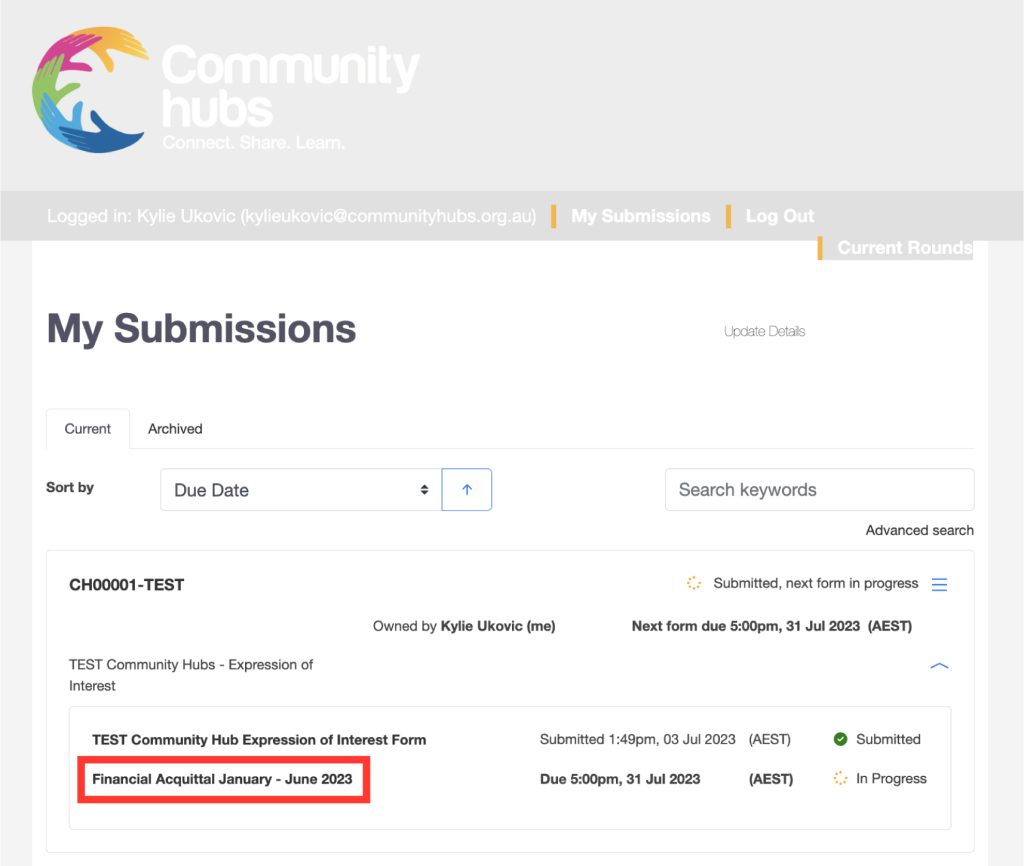
6. Click on the ‘Financial Acquittal January – June 2023’ (highlighted red below) and complete all fields. 
7. Click ‘Submit’ to upload your financial acquittal. 

We realise things change, so if your school has not used all of the funding for the six-month period, it can be carried forward to the next period. Where your school reports unspent funds, our Operations Manager, Maurice Syber, will contact your school ahead of the next funding payment.